
The Best EASY Low-FODMAP Chicken Curry (no onion, no garlic)
I’m half Indian, and was taught to cook Indian food by an amazing cousin, Mumtaz, who was a professional cook in Mumbai and author of several cookbooks. One of the key things I remember learning was just how much garlic she used - it was a revelation to me.
So when I started my low-FODMAP journey a few years ago, under the wonderful care of the dieticians at St Thomas’ Hospital here in London, I was alarmed. How would it be possible to cut garlic out of a curry completely and still get that oh so satisfying umaminess?
And the onions! What about the onions? In particular those small pinkish ones that are ubiquitous all over India and melt into the gravy of a curry, adding sweetness and richness. How could these key flavours be replaced?
Well it wouldn’t be possible, surely.
How wrong I was. After a bit of research and a few kitchen experiments I was turning out great tasting Indian food in no time. And not a clove of garlic or an onion in sight.
Of course, it turns out that the huge diversity of Indian culture and cooking includes various groups of people who do not eat onion or garlic either permanently - like the Jains - or temporarily for religious reasons.
Having been through the whole low-FODMAP process, I do quite often use some garlic now, but I have not gone fully back to onions, which turned out to be more of a trigger for my symptoms.
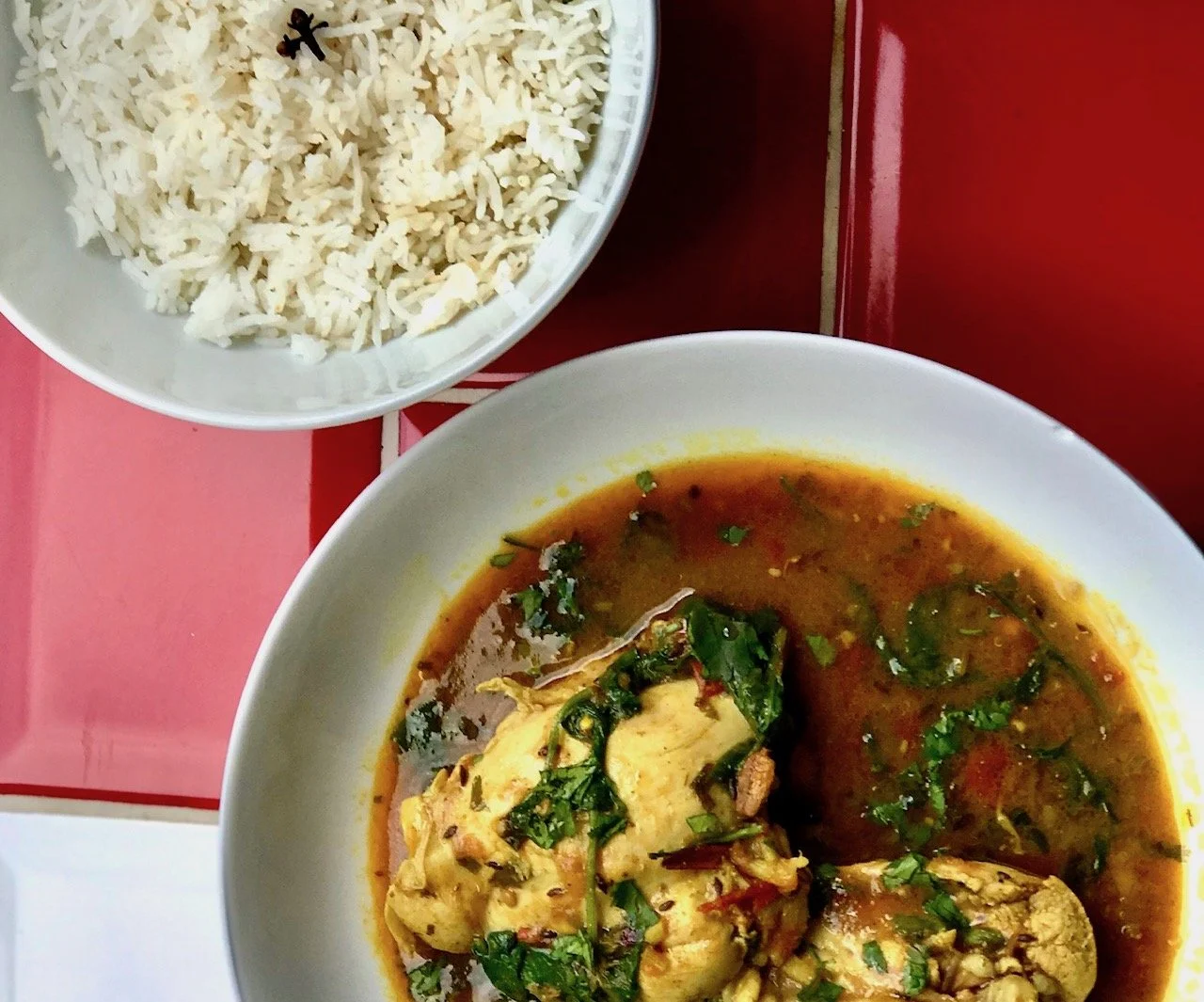
So here is the first low-FODMAP chicken curry I developed and cooked and one that quickly became a staple in my house.
The sweetness that would normally come from the onions is replaced by using tomatoes - fresh or tinned work equally well.
I use fresh coriander stalks to extract more flavour, plenty of ginger (which is low-FODMAP), whole spices and the darker powdered spices - garam masala, cumin. Along with some coconut milk as the cooking liquid the dish tastes dark and rich and is unbelievably moreish. (Tinned coconut is low-FODMAP in the small per-portion quantity used here.)
Various friends that are used to my Indian food have tasted this, loved it, and only afterwards I have told them there is no onion or garlic. Their reaction is always the same - it tastes as good as the food you usually give me!
I use chicken thighs with the skin removed but on the bone. Leave the skins on too if you like. There is more flavour with the bone in and plenty of fat melts into the gravy to make it even more unctuous!
I also add fresh spinach at the end which seems to add another earthy element to the dish, but frozen spinach also works. It’s entirely optional though.
Enjoy this, pass it around, share everywhere, and be not bloated or burpy! Let me know how you get on!
Serves 4
Ingredients
8 chicken thighs, on the bone, skin removed
Juice of 1/2 lemon
Sea salt
2 tbsp any cooking oil
Whole spices: 3-4 cloves, 4-5 green cardamom, 2 black cardamom (optional), a big piece of cinnamon broken up, 1 tbsp cumin seeds
1 bunch of fresh coriander, stalks trimmed and finely chopped
1 fresh chilli chopped
4 large tomatoes, roughly chopped
1 tbsp fresh ginger, chopped
1 tsp garam masala
1 tsp turmeric powder
1 tsp cumin powder
Half a tin of coconut milk (200g)
Half a bag of spinach leaves - about 125g (optional)
Method
Put the chicken thighs in a bowl with a good pinch of sea salt and the juice of half a lemon. Mix well and set aside.
Heat the oil in a large pan on a high heat (I use shop bought garlic oil if I have it) and fry the whole spices for 2 minutes.
Add the finely chopped coriander stems, the chilli and then the tomatoes, along with a pinch of sea salt.
Fry well for a good 5 minutes, stirring frequently - this is the most important stage to extract flavour.
Add the ginger and continue to fry for 2 more minutes.
Add the turmeric, garam masala, cumin powder. Fry for a minute more then push the tomato mixture to the one side of the pan and add the chicken thighs. Colour the chicken on both sides. This will take 5 minutes or so.
Add the coconut milk, another pinch of salt, mix well, cover and simmer for 25 minutes or until the chicken is just done - test by taking a piece out and cutting into it. There should be no pink next to the bone.
If you prefer a thicker gravy, leave the lid off for the last few minutes of cooking.
Throw in half a packet of fresh spinach, or the equivalent quantity of frozen, and just let it wilt (or thaw) for a couple of minutes.
Now the most important part - taste the gravy and add salt until everything tastes in harmony. There is a biting point for a curry like this where the seasoning brings everything together.
When you are happy, turn off the heat and serve immediately over plain rice. Sprinkle over some chopped coriander leaves if you like. Enjoy! Like many curries, this will taste even better the next day when the flavours have melded together more.
Substitutions
1 Any combination of low-FODMAP vegetables would work well with this recipe. For example, potato, aubergine, green beans. Just be careful not to overcook the veggies.
2. I prefer to use fresh tomatoes, but good tinned ones work equally well. Use ½ tin - 200g.
3. The chilli is optional - increase or decrease the amount to taste. Red or green are equally good. It can be a trigger of reflux symptoms so tread carefully.
4. The spinach is optional. If using frozen make sure it is completely melted into the sauce before serving.